Leaks around the chimney, wall joints and vent pipes
Chimney Flashing in Montclair, NJ
Is the stain tracing back to the chimney? Flashing is the thin metal that keeps water out where a roof meets a chimney, wall or vent, and it often gives out before the shingles. Next step: call (973) 358-8198 and say how far the stain sits from the chimney.
Stop and get safe if
- Loose brick or mortar near the chimney top: keep people and cars away from below and do not climb up to check.
- A chimney leaning, or masonry hanging after a storm: stay clear of the base and call 911 if anything is about to fall.
- A wire touching or close to the chimney or roof: back off to 30 feet; the report goes to 911, or to the PSE&G hotline: 1-800-436-7734.
- Water dripping from a light fixture near the chimney wall: get out of that room, touch nothing and call 911 once you are clear of the water.
How a chimney leak travels
- Rain runs down the roof and meets the chimney, where flashing is meant to steer it around. If a gap opens at a joint, water gets behind the metal.
- It then moves down along the boards and insulation, sometimes a long way from the chimney, before it stains a ceiling.
- The stain can appear days after the rain. That delay is why pencilling its edge after each storm and noting its distance from the chimney is useful.
- Have those notes ready when you call (973) 358-8198.
Where the trouble starts
- Metal worn or rusted through at the base of a brick chimney
- Flashing pulled away from a wall where two roof levels meet
- Pinholes in old flashing, which the National Park Service says admit large amounts of water
- Sealant or mastic patches that hardened and cracked
- Mixed metals that corrode where they touch
Short answers
- How urgent is a chimney leak, by your number out of ten?
At 8 to 10 there is water at a fixture, loose masonry or a wire down, and 911 or PSE&G comes first. At 4 to 7 a stain near the chimney grows after rain, so call (973) 358-8198 within the week. At 1 to 3 a faint stain has stopped: pencil its edge and watch.
- Why is flashing the usual suspect?
The asphalt roofing trade group describes flashings as a roof's most vulnerable points. The National Park Service calls them the weakest point in any roof and adds that metal flashing often wears out before the slate it protects.
- Will a tube of sealant do the job?
The National Park Service says mastic and sealants harden, crack and let water in, so they are not a viable repair on a slate roof. Sealant can still be part of a flashing job, but the metal and the way it overlaps are what shed water.
- Does the kind of metal matter?
On historic roofs, yes. The National Park Service's minimum is 16-ounce copper and it urges one metal throughout the flashing and rainwater system to avoid corrosion. Glen Ridge's guidelines name copper, terne-plated and galvanized sheet metal among the historic flashing materials.
- Does a flashing call reach Bloomfield and West Orange?
Yes. Bloomfield roofing and West Orange roofing each have a page. Dial (973) 358-8198 from either town.
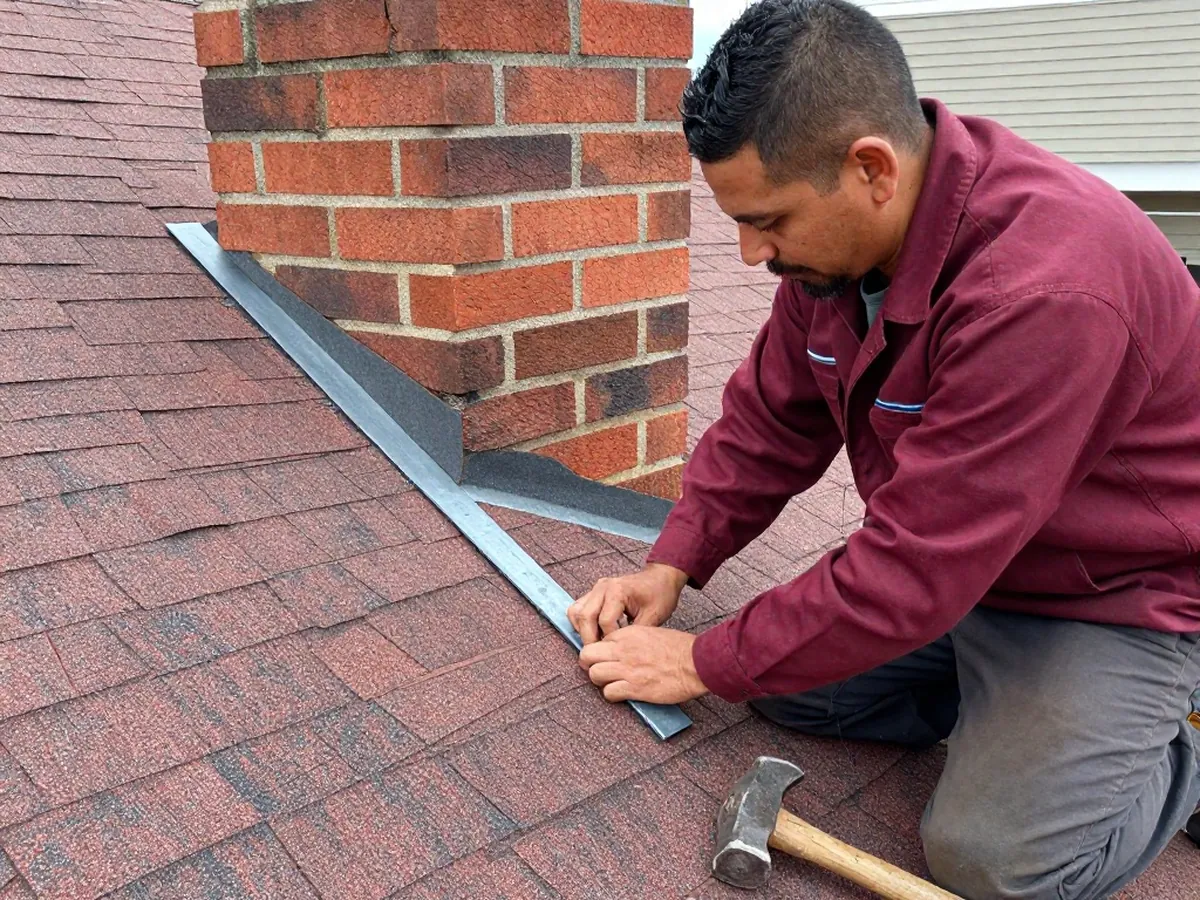
Metal bent into a brick joint
The picture shows a gloved hand bending a piece of gray metal into the joint at the base of a red-brick chimney, with shingles stepped up beside it. Flashing works in layers, each piece lapping over the one below so water runs out and over, never in.
The scene is rendered, not a photo of a particular chimney.
On a visit
- Call (973) 358-8198 and say how far the stain is from the chimney, wall or vent; the contractor can then arrange a visit.
- The metal itself: type, thickness, rust, gaps and pinholes.
- Joints: where flashing meets brick, siding and shingles, and how each overlaps the next.
- Sealant: what has been used, how old it is and whether it has cracked.
- The roof around the flashing, since a failing joint often hides a second problem nearby.
- Options, from resetting and resealing to replacing the metal, plus the historic-house question where it applies.
Reseal or replace the metal
- A tight joint with an old bead of sealant: reseal, and write the date down.
- Metal rusted or pitted: ask about new flashing in a metal that suits the roof.
- Gaps where flashing meets brick: ask about resetting it into the mortar joint.
- A leak that returns after a reseal: expect the answer to be the metal, not more sealant.
- An old house with copper or built-in work: ask whether the crew has worked with copper before.
Flashing, historic copper and the township
On a one- or two-family house that stands alone, flashing work on an existing roof falls under the state's ordinary-maintenance list as part of roof covering repair. Chimney structure and masonry rebuilding are a separate matter, and the state notice does not address them.
Historic districts add reviews: Glen Ridge's commission looks at roof material changes, and Montclair's local districts and landmarks need a Certificate of Appropriateness for changes that alter appearance. Details on the rules page.
More roof jobs
Sources National Park Service, The Repair, Replacement, and Maintenance of Historic Slate Roofs (Preservation Brief, 1993) Asphalt Roofing Manufacturers Association, Assessing roof damage after Superstorm Sandy (7 Nov 2012) U.S. Department of Energy, Repairing Roofs and Ceilings technical brief (Jan 2006) FEMA, Asphalt Shingle Roofing for High Wind Regions, Technical Fact Sheet No. 7.3 (Dec 2010) Borough of Glen Ridge Historic Preservation Commission, Historic Design Guidelines (2021), roof section Building America Solution Center (U.S. DOE), Construct roofs and attics for ice dam prevention (6 Dec 2022)
Describe the roof, then dial.
Before you call (973) 358-8198, find the street address, note which room shows water and jot down roughly how old the roof is. Tenants: the owner arranges roof work, so the landlord hears about it first. Towns: Montclair, Glen Ridge, Bloomfield, West Orange, Cedar Grove, Clifton, Little Falls.